Disposable sleeves for a food plant: when you need them and how to choose
Disposable sleeves for a food plant: when to use them, how to choose color and quantity, and how they compare with a gown or an apron with sleeves. A concise pre‑purchase guide.
 Image for illustration only · Created by AI
In short
Disposable sleeves provide targeted coverage for the forearms and sometimes part of the arm, when there is no need to change a full garment. They pair well with an apron or a short jacket, and in departments where the work is wet or causes localized soiling. The right choice is determined by the task type, replacement habits, color for separating departments, and packaging that matches your consumption pace. When broader coverage is needed, consider a gown or a long‑sleeve garment, and calculate monthly consumption by shifts to order the correct quantity.
- Disposable sleeves are suitable for localized forearm coverage and complement an apron or short garment.
- Choose between blue and white to separate departments or for easy identification on the floor.
- Compare against a long‑sleeve gown or jacket, or an apron with sleeves, based on the desired coverage.
- Plan orders by workers per shift, replacement frequency, and pack size.
- Check that packaging and size fit the department’s distribution and donning processes.
When are disposable sleeves used in a food plant?
Use them when targeted coverage is needed for forearms and arms without changing a full garment, or when a localized reinforcement to an apron is required. They are useful for wet work and for seasoning, cutting, washing, and packing tasks where the arm area soils more than the garment.
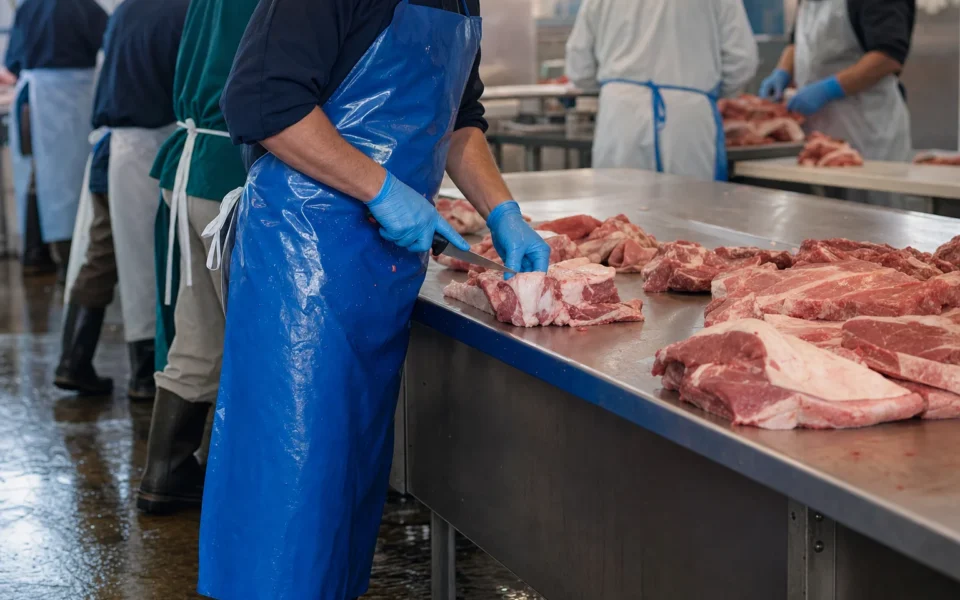
Disposable sleeves are a quick, flexible solution when the active zone is the forearm, for example near wash sinks, at deboning and cutting stations, and when assembling ready‑to‑pack meals. Instead of changing a gown or jacket frequently, add a sleeve as needed and remove it when the task ends.
They are especially suitable when a worker wears a short jacket or apron that does not cover up to the elbow, or when there is frequent movement between stations with varying soiling risk. This helps maintain workflow continuity and order at distribution points.
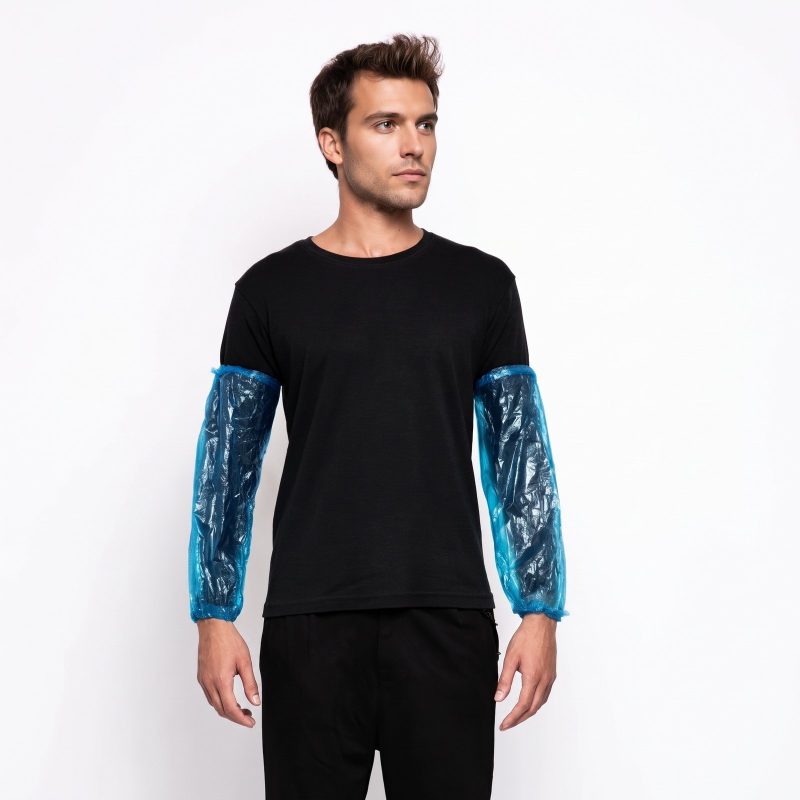
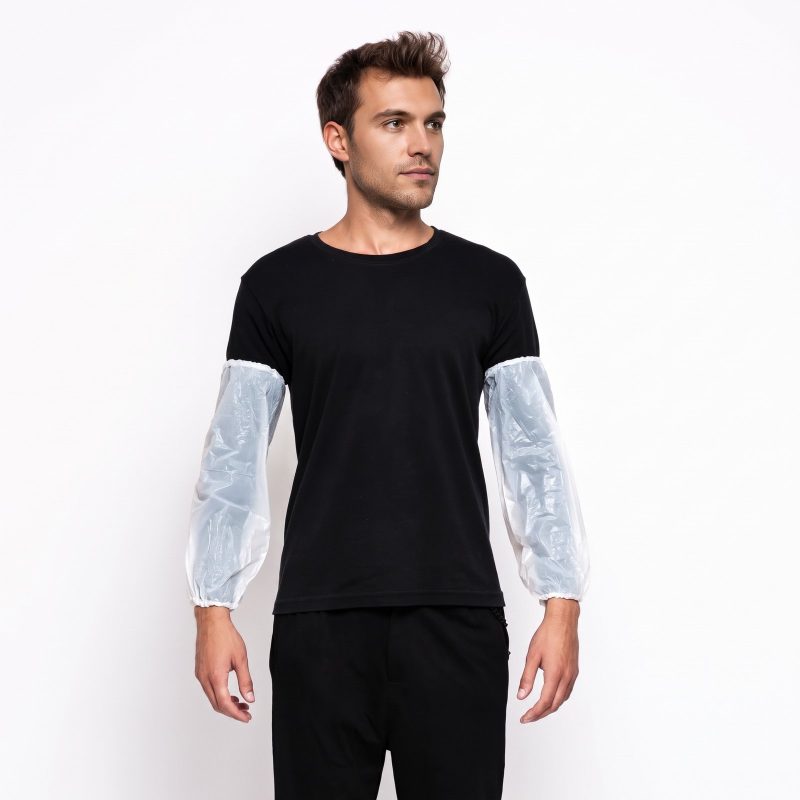
The two common catalog colors are blue and white, enabling a visual distinction between departments, different workdays, or stages in the production process.
How to choose disposable sleeves for a food plant?
Choose by task type, required color for internal separation, pack size, and replacement frequency in each department. Ensure compatibility with an existing apron or garment and with your field distribution procedures.
In food plants, operating convenience is key. If most soiling is around the forearms, sleeves will suffice; if there is splatter over the entire upper body, consider a long‑sleeve garment or an apron with integrated sleeves. Blue or white can support internal separation policies, team identification, and zone differentiation.
Check pack size against the department’s consumption rate: sleeves in the catalog come in packs of 100 units, making it easy to plan by shifts. One Size usually fits most workers, but it’s important to run an on‑floor trial at a representative station.
Plan convenient distribution points and define when to replace: at shift start, between tasks, or as needed. Coordinating with glove and apron use can reduce uncontrolled package openings.
- Material: nylon for quick pairing with an apron or gown.
- Color: blue or white for department separation and visual preference.
- Packaging: 100 units for organizing by shift or department.
- Size: One Size; verify real‑world fit with a small sample.
- Combination: worn over existing garments, with an apron or jacket.
 Image for illustration only · Created by AI
Disposable sleeves or a long‑sleeve garment? A focused comparison
For localized, flexible coverage choose sleeves; for broad, consistent coverage choose a gown, jacket, or an apron with sleeves. The decision depends on the extent of soiling and your replacement routine.
When forearms soil frequently but the rest of the body stays clean, sleeves can reduce frequent changes of a full garment. Conversely, when the work area creates wide splatter or repeated contact around the chest and shoulders, a long‑sleeve gown or jacket provides uniform coverage. There is also a middle option of an apron with integrated sleeves, covering the front and arms together.
| Item | Material | Colors | Size | Quantity per pack | Usage notes |
|---|---|---|---|---|---|
| Disposable sleeves, blue · SKU 121 | Nylon | Blue | One Size | 100 units | Forearm coverage and flexible replacement |
| Disposable sleeves, white · SKU 1211 | Nylon | White | — | 100 units | Color separation by department |
| Disposable long‑sleeve gown · SKU 126 | Nonwoven | White | One Size | 10 units | Full upper‑body coverage with sleeves |
| Disposable long‑sleeve jacket · SKU 1912 | Nonwoven | White | — | 10 units | For a neat, uniform team look |
| Envelope apron + long sleeve, blue · SKU 105 | Nylon | Blue | One Size | 10 units | Front and arm coverage together |
How many to order and how to plan monthly consumption?
Calculate by workers per shift, number of shifts, replacement frequency, and pack size. Do a simple calculation and add a safety factor at your discretion.
The effective way to avoid shortages is to translate the replacement routine into boxes. Define how many workers use sleeves in each shift, how many shifts per day, how many units are needed per worker, and how many workdays per month. Compare with the 100‑unit pack content to derive the number of packs per month.
Example for illustration: suppose there are 30 workers per shift and two shifts per day. Suppose each worker uses two sleeve units per shift. Each shift consumes 30×2 = 60 units. In two shifts per day that’s 60×2 = 120 units per day. If there are 22 workdays per month, monthly consumption is 120×22 = 2,640 units. With 100 units per pack you need 2,640÷100 = 26.4 packs, i.e., round to 27 base packs. If you choose a 10% safety factor, that’s about 2.7 more packs, so round to 30 packs per month.
In a smaller department, or if replacements are only at shift start, the numbers will decrease accordingly. Conversely, if there are tasks that require replacement during the shift, update the multipliers and add a reserve for unexpected soiling.
Blue or white: choosing colors and separation in the department
The two available sleeve colors are blue and white, and they can be used to separate departments, shifts, and roles. Choose a color that will be clearly visible in your work environment.
In different departments it is common to mark roles or zones in different colors, to quickly identify movement between areas or to maintain process separation. Blue sleeves stand out against most uniforms and their visibility supports visual control. White is perceived as clean and aligns with dry or dairy processing environments, depending on your organizational culture.
In the catalog you will find blue sleeves in a pack of 100 units, alongside white sleeves in the same configuration. Maintaining two separate inventories allows flexible allocation by line, shift, and department.
How to organize dispensing and replacements on the floor?
Place accessible distribution points, define rules for opening packs, and map out a disposal route for safe discarding. Run brief end‑of‑shift counts to detect anomalies.
Organize the 100‑unit packs in a cabinet dedicated to each department and mark contents and opening date. Define who is authorized to open a new pack and when, to minimize loss and stray single units. Add a separate collection bin for used sleeves along the exit route from the dirty area.
Train workers on efficient donning and doffing alongside gloves and an apron, to prevent over‑replacement. Review weekly consumption against output and cross‑check against orders. A brief log in a terminal or departmental sheet will help spot deviations early, for example a spike in consumption on a particularly wet day.
How to choose a supplier of disposable clothing in volume?
Look for a clear catalog, available colors and consistent packaging identities, and the option to request a quote by quantity and department. Ensure there are complementary products in the same category for simple inventory management.
A supplier with a spread of clothing and protective products lets you purchase smartly not only sleeves but also caps, gowns, and aprons within the same operational language. Check that packs are consistent and that it’s easy to communicate quantities by shifts. Request an organized quote per box and per annual quantity to sync with your consumption forecast.
Dogans Ltd., owner of the brand TITANIC, has operated as a family business since 1991 and imports and distributes disposable clothing and protection for businesses alongside additional packaging products. The website does not display prices, and you can send a request for a quote by product, size, and quantity via the request a quote page.
- Check a single, consolidated product category for clothing and protection.
- Ensure color availability and consistent packaging identities across items.
- Assess compatibility with complementary products in the same category.
- Compare supply terms by quantities and by departments.
Quick check‑list before ordering
- Define use: localized forearm coverage or broader coverage.
- Choose color: blue or white by department separation.
- Verify on‑floor fit across a range of arm sizes (quick sample).
- Calculate monthly consumption by workers, shifts, and workdays.
- Coordinate distribution points and rules for opening packs.
- Plan integration with existing apron, gown, or jacket.
- Set a clear replacement policy and communicate it to teams.
- Update the quarterly forecast based on actual usage data.
Frequently asked questions
What is the operational advantage of sleeves versus a gown or jacket?
The advantage is flexibility: when most soiling is on the forearms, you can replace sleeves frequently without disrupting workflow. A long‑sleeve gown or jacket fits better when broad coverage of the entire upper body is required. The choice depends on the station, the liquids involved, and your replacement routine.
How should each department decide on the sleeve color?
The color decision stems from process separation and visibility. Blue is prominent and easy to identify visually from different sightlines, while white conveys cleanliness and supports a uniform look. You can define colors by department, by shift, or by raw‑material type for quick on‑floor identification.
What’s the difference between nylon sleeves and nonwoven clothing for forearms?
Nylon sleeves provide targeted, flexible coverage for the forearm area and pair well with aprons. Clothing made of nonwoven, such as a gown or jacket, provides broader coverage of the entire upper body and suits situations with continuous contact around shoulders and chest. The decision depends on the soiling pattern and station routines.
What pack sizes are sleeves available in within the catalog?
The catalog offers 100‑unit packs for sleeves, in blue and in white. Fixed‑size packs make monthly planning by shifts and department distribution easier. If you have small stations, one box can be shared across several posts with daily consumption logging.
Whether you need sleeves for wet work areas or a flexible solution for quick replacement, the key is task‑based selection and shift‑based consumption planning. We’ll be glad to receive a basic usage and quantities brief from you and prepare a structured quote for disposable clothing in volume.