Nitrile gloves for the food industry: how to choose a supplier and glove
Nitrile gloves for the food industry: comparison before purchase, supplier selection, and defining quantities and sizes. A practical guide with tips for inventory management and color separation by departments.
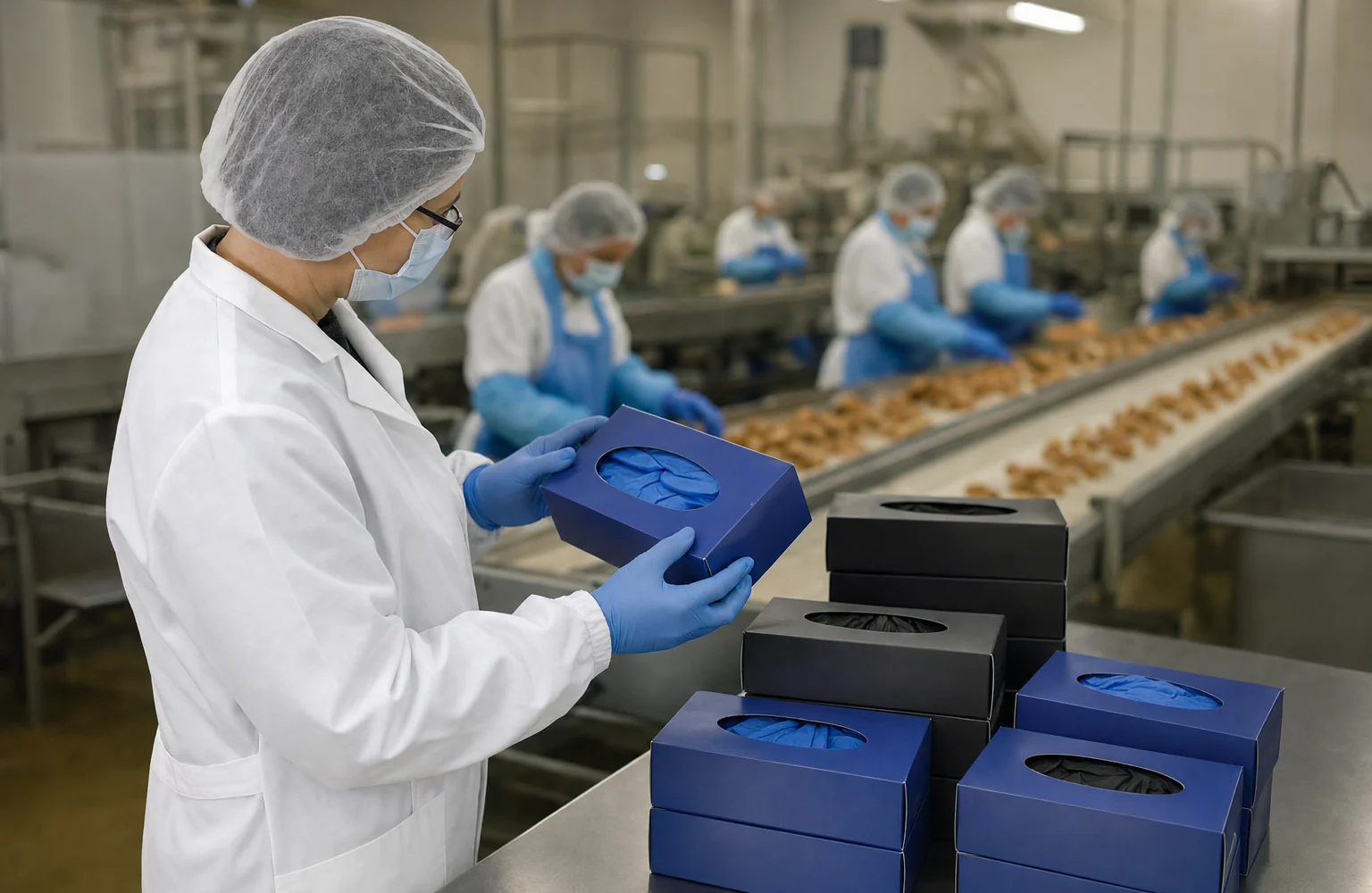 Image for illustration only · Created by AI
In brief
Nitrile gloves for the food industry are a common choice on production lines, in butcheries, and in professional kitchens thanks to availability in sizes S to XL and colors that enable role-based differentiation. Before choosing, define usage by department, colors, and sizes, and check that the operating spec matches your need. Then calculate monthly consumption based on actual changeover rates and request an organized quote by color and size. This way you’ll compare suppliers based on data, not gut feel.
- Define in advance the uses, colors, and sizes by departments and roles.
- Look for powder-free nitrile models in sizes S–XL, and verify continuity of supply for those sizes.
- Compare suppliers based on 100-unit box packaging, color availability, and support for department-based ordering.
- Manage inventory according to real field consumption and a monthly unit calculation per size.
- Request a detailed quote by size, color, quantity, and inner packaging.
Why nitrile gloves for the food industry?
Nitrile gloves for the food industry are available powder-free, in a range of sizes and colors that enable department-based management. They are suitable for routine work in wet or greasy environments and for color-based visual control.
In daily work in professional kitchens, on packaging lines, and in butcheries, the need is for a durable, disposable, powder-free glove that comes in sizes S to XL and can be differentiated by color. The glove catalog includes powder-free nitrile models in blue or black, in 100-unit boxes, making it easy to set a uniform standard across shifts.
The two key decisions in nitrile are color and size: blue is suitable when high visibility is needed on a light production line, and black is preferred in areas where a clean look is desired even when working with dark sauces and spices. In both cases, managing by size and department simplifies inventory counts and operational control.
How to choose a supplier for gloves for food plants?
Choose a supplier that maintains continuity of supply for the same models, colors, and sizes, and can build a quote segmented by departments. Ensure support for steady quantities over time and flexibility to balance colors and sizes.
Because consumption is steady by nature, the expectation from a supplier is consistent availability of the same nitrile model, in the same sizes and colors. Ask to confirm rolling inventory based on a forecast, and end-user-friendly packaging methods, for example 100-unit boxes in every size.
Also consider the ordering method: can you submit orders by department and by size, with clear labeling on the boxes. Ask to formalize a process for handling count discrepancies or quality complaints, and coordinated handoff of boxes at warehouse receiving.
It’s recommended to confirm alignment with your quality procedures, the manufacturer’s instructions, and the regulations applicable to you before a broad rollout of a new model.
- Continuity of supply for the same nitrile models in the defined colors and sizes.
- User-friendly packaging: 100-unit boxes; clear labeling of size and color.
- Ability to lock in a mix by departments and reflect it in inventory and invoices.
- Structured process for handling issues, breakage, and count variances.
- Option for recurring standing orders at a fixed cadence.
 Image for illustration only · Created by AI
Which glove suits which application?
Match the glove type to the actual application: powder-free nitrile for routine work around food, latex in the same scenarios per procedures, and nylon for short-contact tasks. Define colors by department.
Below is a practical mapping based on current catalog items. It helps with comparison and selection by material type, sizes, color, and packaging. Make the final fit against your internal procedures and the manufacturer’s instructions.
| Glove type | Example models | Catalog attributes | Available sizes | Packaging | Usage notes |
|---|---|---|---|---|---|
| Powder-free nitrile – blue | Product: Blue powder-free nitrile gloves · 100 units (SKU 156) | Material: Nitrile, Color: Blue, Country of manufacture: Thailand | S, M, L or XL | 100 units | A common choice for department separation by color |
| Powder-free nitrile – black | Product: Black powder-free nitrile gloves · 100 units (SKU 156) | Material: Nitrile, Color: Black, Country of manufacture: Thailand | S, M, L or XL | 100 units | Suitable when a neutral dark look is preferred |
| Powder-free latex | Product: Powder-free latex gloves · 100 units (SKU 141) | Color: White, Country of manufacture: Thailand | S, M, L or XL | 100 units | Alternative subject to internal procedures |
| Disposable nylon | Product: Nylon gloves in a box (SKU 153) | Size: One Size, Color: Transparent, Country of manufacture: China | One Size | 100 units or 500 units | For short contact or hospitality |
How to match sizes and quantities by department?
Build a consumption standard for each department, calculate monthly units per size, and convert to 100‑unit boxes. For colors, split the quantity between departments by actual usage share.
The efficient way to stabilize inventory is a simple standard: how many gloves an employee in a specific role changes per shift, and how many employees per shift. From this you derive daily, weekly, and monthly unit totals. It’s important to calculate in single units, not pairs, because the packaging is 100 units.
Illustrative example only: in an institutional kitchen there are 18 employees using nitrile gloves. Each employee changes on average 4 pairs per day, i.e., 8 units per day. Total units per day: 18 employees times 8 units equals 144 units. Assuming 22 working days per month: 144 times 22 equals 3,168 units per month. Since each box contains 100 units, divide 3,168 by 100 to get 31.68 boxes. Round up to 32 boxes per month.
Split by sizes: if the size distribution is 60% M, 30% L, and 10% S, multiply 3,168 units by each percentage. M: 3,168 times 0.60 equals 1,900.8 units, i.e., 20 boxes. L: 3,168 times 0.30 equals 950.4 units, i.e., 10 boxes. S: 3,168 times 0.10 equals 316.8 units, i.e., 4 boxes. Total 34 boxes after rounding up in each size; this includes a small safety factor compared with the 32 boxes calculated without size breakdown.
The same principle works for splitting colors by departments: if butchery works in black and packaging in blue, divide the monthly quantity for each color by the active headcount and changeover frequency.
Blue or black – what’s right for your line?
Choose color by preferred visibility on the plate or the production line, and sync with department tagging. Blue stands out in light environments; black is neutral and helps maintain a clean look.
In production where it’s important to quickly identify glove remnants on light-colored raw materials, blue provides contrast. On a butchery line or when working with dark spices, black is a clean, discreet choice through end of shift. Both options are available in 100‑unit boxes, in sizes S to XL.
Operational tip: mark color‑by‑department in your procurement and warehouse system so each box reaches the correct work area without confusion. This step may reduce allocation errors and maintain consistency.
What to check in the quote and in ongoing supply?
Request a detailed quote by model, color, size, and total monthly quantity, with inner packaging breakdown. Define supply frequency, control process, and a reference to SKU numbers.
To compare suppliers, compare apples to apples: the same powder-free nitrile glove, in the same color and size, in the same 100‑unit packaging. Ask to reflect the SKU and country of manufacture on every line in the document to keep consistency between orders.
Two more items that simplify operations: a fixed template for delivery notes with breakdown by department and size, and a structured process to update the monthly forecast according to actual consumption. This helps balance better between overstock and shortage.
- Full breakdown of glove models by color and size (for example: Blue S, Black L).
- Inner packaging to a 100‑unit box; clear size marking.
- Approved monthly quantity as the basis for pricing and comparison.
- Relevant SKU numbers and country of manufacture in the documents.
- Procedures to correct invoices in case of cross‑department swaps.
Who is the supplier and what else is available?
Dogans Ltd., owner of the TITANIC brand and operating since 1991, imports and distributes to businesses a range of disposable gloves alongside packaging equipment. You can submit an organized request for a quote by quantities and sizes.
In the glove catalog you’ll find powder-free nitrile gloves in blue or black, alongside other options such as latex and nylon. Since prices do not appear on the site, each quote is built by product, size, and quantity. You can send a request through the request a quote page and define a mix by departments.
For distributors and branded organizations, it’s possible to consider shrink packaging and product branding subject to fit assessment and a quote. If you’d like to learn about the company and its local manufacturing areas (aluminum trays and aluminum foil, cling film, and baking paper), you can read more on the About Dogans page.
Quick checklist before finalizing a nitrile glove supplier
- Define uses by department: where is nitrile required? Where is nylon sufficient?
- Select operational colors (blue for packaging, black for butchery) and align with the warehouse.
- Set S–XL size distribution based on real field data.
- Calculate monthly consumption in units and convert to 100‑unit boxes per size.
- Verify SKUs, colors, sizes, and country of manufacture in the quote and supply documents.
- Agree on a process to handle count variances and packaging issues.
- Define a fixed supply frequency and update forecasts based on actual consumption.
- Clear departmental labeling on cartons and boxes.
FAQs
Should we choose blue or black nitrile gloves?
Choose by visibility and department coordination. Blue provides high contrast on a light production line; black gives a uniform look when working with dark materials. Both options are powder-free, available in sizes S to XL, and in 100‑unit boxes.
How do we determine the right size distribution?
Start with a sample count of employees by hand size, update the standard based on observed changeovers, and track during the first month to calibrate. Keep a small safety stock in popular sizes and adjust the mix according to actual pull data.
What is the operational difference between nitrile and latex?
Both are disposable, powder-free, and available in sizes S–XL. The choice depends on operational preferences and fit with internal procedures. Compare packaging, available colors, and supply paths for the specific model you’re evaluating.
How do we calculate how many boxes to order each month?
Define changeovers per employee per day, multiply by the number of employees and monthly workdays to get units. Divide by 100 to get boxes, and round up for each size separately. Keep records and compare to actual consumption to calibrate the next order.
To quickly move to nitrile models in the colors and sizes that fit your needs, visit the glove category and choose the right classification by department. Then send a breakdown of quantities and sizes to receive an organized quote tailored to your consumption.